Sweeps#
This notebooks explains sweeping in Pulla, that is, performing a loop over a settings value. It is recommended to run Configuration and Usage.ipynb before this notebook.
%matplotlib inline
import numpy as np
from copy import deepcopy
from IPython.core.display import HTML

from qiskit import QuantumCircuit

from iqm.iqm_client.util import print_env_vars
from iqm.qiskit_iqm import IQMProvider
from iqm.pulla.pulla import Pulla
from iqm.pulla.utils_qiskit import get_qiskit_compiler
from iqm.pulse.playlist.visualisation.base import inspect_playlist
from iqm.pulse.timebox import TimeBox
from iqm.pulse.builder import ScheduleBuilder
from iqm.pulse.playlist.schedule import Segment, Schedule
from iqm.pulse.playlist.instructions import Block
print_env_vars()

pulla = Pulla()
backend = IQMProvider().get_backend()
Qiskit Compiler#
When running Qiskit circuits through IQM Pulla, one way is to first transpile the circuit manually in your notebook/script, convert the circuit to the IQM representation, and finally compile the circuit for execution.
However, when working on the pulse level, one usually wants to control the routing and transpilation exactly (e.g. route to specific qubits in the chip), whereas the Qiskit transpiler is stochastic in nature. For facilitating pulse-level access in the context of Qiskit, one can use the function get_qiskit_compiler. It returns a Pulla compiler which contains the transpilation and conversion to IQM format compiler passes, so that users may just provide native Qiskit QuantumCircuits directly. It also allows easy routing to a subset of a chip.
compiler = get_qiskit_compiler(pulla, backend)

# Show the settings for the transpilation stage pass
compiler.get_settings(circuits=[]).stages.qiskit_transpilation.parallelize_and_transpile
(stages.qiskit_transpilation.parallelize_and_transpile)
stages.qiskit_transpilation.parallelize_and_transpile: (Name: "stages.qiskit_transpilation.parallelize_and_transpile", class:SettingNode) 0
| perform_move_routing | True | perform_move_routing | |
| optimize_single_qubits | True | optimize_single_qubits | |
| ignore_barriers_in_1qb_optimization | False | ignore_barriers_in_1qb_optimization | |
| remove_final_rzs | True | remove_final_rzs | |
| existing_moves_handling | not set/auto | existing_moves_handling | |
| optimization_level | 0 | optimization_level | |
| seed_transpiler | not set/auto | seed_transpiler | |
| num_processes | not set/auto | num_processes |
# Display the docstring for the stage pass
compiler.show_stages(pass_name="parallelize_and_transpile")
Circuit-level Stages (3)
Stage 0: qiskit_transpilation Transpile and route Qiskit circuits to the correct architecture.
| Pass 0: parallelize_and_transpile | list[list[QuantumCircuit]] |
|
Full Signature
(
Documentation
circuits: 'list[QuantumCircuit]',components: 'ComponentGrouping | None',context: 'dict[str, Any]',perform_move_routing: 'bool' = True,optimize_single_qubits: 'bool' = True,ignore_barriers_in_1qb_optimization: 'bool' = False,remove_final_rzs: 'bool' = True,existing_moves_handling: 'str | None' = None,optimization_level: 'int' = 0,seed_transpiler: 'int | None' = None,num_processes: 'int | None' = None) -> list[list[QuantumCircuit]] Transpile Qiskit circuits and parallelize them if colour grouped components were inputted.
Args:
circuits: List of Qiskit QuantumCircuit objects to transpile and potentially parallelize.
components: List of (physical) components on which to transpile (route) the circuits. If a flat list of
components is provided, the IQMTarget will be built only on that subset of the full QPU. If colour
grouped components (i.e. of the form ``list[list[tuple(str, ...)]]``) is provided, the circuits will
be parallelized such that each colour group becomes its own circuit, and the circuit will be broadcasted
to parallel groups within a colour group, i.e. executed parallelly. If ``None`` is provided, the default
target for the full QPU will be used.
context: The Compiler context.
perform_move_routing: Whether to perform MOVE gate routing.
optimize_single_qubits: Whether to optimize single qubit gates away.
ignore_barriers_in_1qb_optimization: Whether to ignore barriers when optimizing single qubit gates.
remove_final_rzs: Whether to remove the final z rotations.
existing_moves_handling: How to handle existing MOVE gates in the circuit, required if the circuit contains
MOVE gates.
optimization_level: The optimization level of the Qiskit transpiler.
seed_transpiler: The seed of the Qiskit transpiler.
num_processes: The number of parallel processes to use.
Returns:
Transpiled and possibly parallelized circuits. The circuit(s) in each inner list are executed in parallel.
If there is no parallelization, each inner list has just one item.
|
|
Stage 1: qiskit_to_iqm Convert Qiskit circuits into the internal circuit representation.
| Pass 0: qiskit_circuits_to_iqm_circuits | list[Circuit] |
|
Full Signature
(
Documentation
circuits: 'list[list[QuantumCircuit]]',components: 'ComponentGrouping | None',context: 'dict[str, Any]') -> list[Circuit] Convert Qiskit QuantumCircuits to IQM circuits.
Args:
circuits: Qiskit QuantumCircuit objects to compile. The circuits in each inner list are executed in parallel.
components: Physical components on which to compile the circuits. If ``None``, will use the default IQMTarget
in the Qiskit backend, otherwise restricts to these components.
context: The Compiler context.
Returns:
Converted IQM circuits.
|
|
Stage 2: circuit_stage Perform Circuit-level transformations.
| Pass 0: validate_settings | list[iqm.pulse.circuit_operations.Circuit] |
|
Full Signature
(
Documentation
circuits: list[iqm.pulse.circuit_operations.Circuit],settings: exa.common.data.setting_node.SettingNode) -> list[iqm.pulse.circuit_operations.Circuit] Validate the settings for circuit execution options (only some combinations make sense).
Raises an error if full MOVE gate tracking is used without move gate validation. Raises a warning if terminal
measurements would be used with active reset.
Args:
circuits: The circuits to compiler.
settings: The settings tree to validate.
Returns:
The circuits as they were.
Raises:
CircuitError: if full MOVE gate tracking is used without move gate validation.
|
|
| Pass 1: map_components | Iterable[iqm.pulse.circuit_operations.Circuit] |
|
Full Signature
(
Documentation
circuits: collections.abc.Iterable[iqm.pulse.circuit_operations.Circuit],component_mapping: dict[str, str] | None,context: dict[str, typing.Any]) -> Iterable[iqm.pulse.circuit_operations.Circuit] Maps the logical component names in a sequence of instructions to the corresponding physical component names.
Modifies ``instructions`` in place. If no mapping is provided, returns the circuits as they are.
Args:
circuits: The circuits to compiler.
component_mapping: Mapping of logical component names to physical component names.
``None`` means the identity mapping.
context: The Compiler context.
|
|
| Pass 2: subscribe_and_probe | list[iqm.pulse.circuit_operations.Circuit] |
|
Full Signature
(
Documentation
circuits: list[iqm.pulse.circuit_operations.Circuit],settings: exa.common.data.setting_node.SettingNode,context: dict[str, typing.Any],additionally_subscribed_components: list[str],additionally_probed_components: list[str],probe_all: bool = True,convert_terminal_measurements: bool = True) -> list[iqm.pulse.circuit_operations.Circuit] Add additional terminal measurements to the circuit and modify measurement instruction arguments.
The additional measurements can be subscribed to (i.e. they'd return measurement data) or be just probe pulses
for potentially improving the terminal measurement fidelity in case the measurement calibration is not 100%
factorizable.
In addition, the pass hashes all readout keys since there is a data processing limit for the readout key length.
The keys should then be unmapped in the return data post-processing. The terminal measurements can also be converted
to the ``measure_fidelity`` operation which is calibrated to maximize the fidelity while not necessarily being
projective (QNDness is typically not important for the terminal measurement).
Args:
circuits: The circuits to compile.
settings: The settings tree.
context: The Compiler context.
additionally_subscribed_components: Additional components to measure in the terminal measurement (besides the
ones explicitly measured in the circuit itself).
additionally_probed_components: Additional components to send the probe pulse to besides the
ones explicitly measured in the circuit itself). The measurement data will not be collected from these
components.
probe_all: Whether to send to probe pulse to all components in the terminal measurement (overrides
``additionally_probed_components``).
convert_terminal_measurements: Whether to convert the terminal measurement data to the ``measure_fidelity``
operation that is calibrated to maximize the fidelity while not necessarily being QND. This option will
be turned to ``False`` automatically if active reset is used (active reset is not reliable in the presence
of leakage).
Returns:
The circuits with the aforementioned modifications.
|
|
| Pass 3: validate_circuits | list[iqm.pulse.circuit_operations.Circuit] |
|
Full Signature
(
Documentation
circuits: list[iqm.pulse.circuit_operations.Circuit],builder: iqm.pulse.builder.ScheduleBuilder,context: dict[str, typing.Any],move_gate_validation: bool = True,validate_prx: bool = True,validate_calset: bool = False) -> list[iqm.pulse.circuit_operations.Circuit] Validate circuits and aggerate metrics data from them.
Args:
circuits: The circuits to compile.
builder: The ScheduleBuilder.
context: The compiler context.
move_gate_validation: Whether to do the move gate validation.
validate_prx: Whether to do the validation.
validate_calset: Whether to validate the calibration set (if the calibration point used is not from a
calibration set, this validation might not make sense).
|
|
Pulse-level Stages (5)
Stage 0: circuit_resolution Resolve Circuits into TimeBoxes.
| Pass 0: resolve_circuits | list[iqm.pulse.timebox.TimeBox] |
|
Full Signature
(
Documentation
circuits: list[iqm.pulse.circuit_operations.Circuit] | list[iqm.pulse.timebox.TimeBox],builder: iqm.pulse.builder.ScheduleBuilder,scheduling_strategy: str = 'ASAP') -> list[iqm.pulse.timebox.TimeBox] Resolve the circuits to timeboxes.
Args:
circuits: The circuit to resolve.
builder: The schedule builder.
scheduling_strategy: Scheduling strategy to be used in the resolved TimeBoxes (see :class:`.TimeBox`).
Returns:
List of TimeBoxes (one TimeBox per circuit).
|
|
Stage 1: timebox_stage Perform TimeBox-level transformations.
| Pass 0: multiplex_readout | list[iqm.pulse.timebox.TimeBox] |
|
Full Signature
(
Documentation
timeboxes: list[iqm.pulse.timebox.TimeBox],timebox_input: bool) -> list[iqm.pulse.timebox.TimeBox] Merge any MultiplexedProbeTimeBoxes inside a TimeBox representing a circuit.
This pass optimizes a situation where multiple "measure" gates on disjoint set of loci exist sequentially in the
circuit.
Without optimization, each gate would result in a separate trigger event, which results in worse performance.
For example, with the measurement instructions [M(QB1), M(QB2), M(QB3)], we'd first measure QB1, then QB2, then QB3.
This optimization merges the measurement timeboxes, so that we'll measure QB1, QB2, and QB3 at the same time
(if the hardware channel configuration allows it), corresponding to M(QB1, QB2, QB3).
Goes through the children of `circuit_box`, and places them in the same temporal order.
Whenever a MultiplexedProbeTimeBox is encountered (i.e. from a measure gate), it is merged with the previous pending
MultiplexedProbeTimeBox and left pending.
If any other box type with colliding loci is encountered, first places the pending MultiplexedProbeTimeBox.
This essentially delays all measurements until the last possible moment.
This stage pass is skipped if the circuits to be compiled were given in the TimeBox-level, as the logic within does
not work for deep recursive TimeBoxes.
Args:
timeboxes: Timeboxes representing circuits.
timebox_input: Whether the circuits were inputted already in the TimeBox format.
Returns:
New TimeBoxes with the same content, except with some MultiplexedProbeTimeBoxes merged.
|
|
| Pass 1: prepend_heralding | list[iqm.pulse.timebox.TimeBox] |
|
Full Signature
(
Documentation
timeboxes: list[iqm.pulse.timebox.TimeBox],builder: iqm.pulse.builder.ScheduleBuilder,context: dict[str, typing.Any],add_heralding: bool = False) -> list[iqm.pulse.timebox.TimeBox] Add the heralding measurement TimeBox to all circuits (locus: active components that can be measured).
Args:
timeboxes: Timeboxes representing circuits.
builder: The ScheduleBuilder.
context: Compiler context.
add_heralding: Whether to add the heralding measurement timebox to the schedules.
Returns:
The timeboxes with the prepended heralding measurement.
|
|
| Pass 2: prepend_reset | list[iqm.pulse.timebox.TimeBox] |
|
Full Signature
(
Documentation
timeboxes: list[iqm.pulse.timebox.TimeBox],builder: iqm.pulse.builder.ScheduleBuilder,context: dict[str, typing.Any],active_reset_cycles: int | None = None) -> list[iqm.pulse.timebox.TimeBox] Add a reset timebox to all circuits for all active components.
Args:
timeboxes: TimeBoxes representing circuits.
builder: The ScheduleBuilder.
context: The compiler context.
active_reset_cycles: Number of active reset cycles applied. `None` means no active reset cycles, in which case
reset is done by relaxation (waiting).
Returns:
The timeboxes with the prepended reset.
|
|
Stage 2: timebox_resolution Resolve TimeBoxes into Schedules.
| Pass 0: resolve_timeboxes | list[iqm.pulse.playlist.schedule.Schedule] |
|
Full Signature
(
Documentation
timeboxes: list[iqm.pulse.timebox.TimeBox],builder: iqm.pulse.builder.ScheduleBuilder,neighborhood: int = 1) -> list[iqm.pulse.playlist.schedule.Schedule] Resolve the timeboxes to schedules.
Args:
timeboxes: TimeBoxes representing circuits.
builder: The ScheduleBuilder.
neighborhood: The neighborhood for the scheduling (see: :meth:`.ScheduleBuilder.resolve_timebox`).
Returns:
The time-resolved schedules (one for each circuit).
|
|
Stage 3: dynamical_decoupling Apply dynamical decoupling sequences to idle qubits in the Schedules.
| Pass 0: apply_dd_strategy | list[iqm.pulse.playlist.schedule.Schedule] |
|
Full Signature
(
Documentation
schedules: list[iqm.pulse.playlist.schedule.Schedule],builder: iqm.pulse.builder.ScheduleBuilder,context: dict[str, typing.Any],dd_is_disabled: bool = True,use_standard_dd_strategy: bool = True,DDStrategy_merge_contiguous_waits: bool = True,DDStrategy_target_qubits: list[str] | None = None,DDStrategy_skip_leading_wait: bool = True,DDStrategy_skip_trailing_wait: bool = True,DDStrategy_gate_sequences_ratio: list[int] | None = None,DDStrategy_gate_sequences_gate_pattern_xy: list[str] | None = None,DDStrategy_gate_sequences_align: list[str] | None = None) -> list[iqm.pulse.playlist.schedule.Schedule] Insert dynamical decoupling sequences into the schedules, if dynamical decoupling is enabled.
DDStrategy can also be read from the Compiler context, from under the key `"DDStrategy"`. In this case, the
strategy provided will override the DDStrategy options given as args to this function.
Args:
schedules: Schedules representing the compiled circuits.
builder: The ScheduleBuilder.
context: Compiler context.
dd_is_disabled: Set to ``False`` to enable dynamical decoupling.
use_standard_dd_strategy: Whether to use the standard decoupling strategy (overrides the below arguments).
DDStrategy_target_qubits: The qubits to which DD is applied (``None`` means apply to every applicable qubit).
DDStrategy_merge_contiguous_waits: Whether to merge contiguous waits (see :class:`.DDStrategy`).
DDStrategy_skip_leading_wait: Whether to skip leading waits (see :class:`.DDStrategy`).
DDStrategy_skip_trailing_wait: Whether to skip trailing waits (see :class:`.DDStrategy`).
DDStrategy_gate_sequences_ratio: Minimal durations for the Wait to be replaced with the DD sequence
(in PRX gate durations) in the DD sequence.
DDStrategy_gate_sequences_gate_pattern_xy: XY Gate patterns in the DD sequence. If you want to provide custom
PRX angles instead of XY patterns, you must provide the DDStrategy in the Compiler context.
DDStrategy_gate_sequences_align: Alignments in the DD sequence ("asap", "alap" or "center")
Returns:
THe schedules where applicable Waits are replaced with DD sequences.
|
|
Stage 4: schedule_stage Perform Schedule-level transformations.
| Pass 0: apply_move_gate_phase_corrections | list[iqm.pulse.playlist.schedule.Schedule] |
|
Full Signature
(
Documentation
schedules: list[iqm.pulse.playlist.schedule.Schedule],builder: iqm.pulse.builder.ScheduleBuilder,context: dict[str, typing.Any],move_gate_frame_tracking_mode: str = 'full') -> list[iqm.pulse.playlist.schedule.Schedule] Apply calibrated phase corrections if MOVE gates are used.
|
|
| Pass 1: clean_schedule | list[iqm.pulse.playlist.schedule.Schedule] |
|
Full Signature
(
Documentation
schedules: list[iqm.pulse.playlist.schedule.Schedule],builder: iqm.pulse.builder.ScheduleBuilder) -> list[iqm.pulse.playlist.schedule.Schedule] Remove non-functional instructions from `schedules`.
|
|
Finalization Stages (2)
Stage 0: schedule_resolution Translate Schedules into a hardware-executable Playlist.
| Pass 0: build_playlist_and_merge_contexts | iqm.models.playlist.playlist.Playlist |
|
Full Signature
(
Documentation
schedules: list[iqm.pulse.playlist.schedule.Schedule],builder: iqm.pulse.builder.ScheduleBuilder,context: dict[str, typing.Any],compute_execution_time_metrics: bool = False,ignore_input_components: bool = False) -> iqm.models.playlist.playlist.Playlist Build the playlist from the schedules and merge the contexts for individual sweep spots.
When merging the context, the active components are the union of the active components in each sweep spot
(unless explicitly given by the user). The default context keys are not merged (these should not be modified
by any of the sweep spots), and any other keys in the context will be merged to mapping from the sweep spot id
to the context entry.
Args:
schedules: Schedules to build into a Playlist.
builder: The ScheduleBuilder.
context: The Compiler context.
compute_execution_time_metrics: Whether to compute schedule duration and minimum execution time for circuits.
ignore_input_components: If True, components are always replaced with the ones found in context.
Returns:
The Playlist containing schedules.
|
|
Stage 1: job_creation Package the Playlist and metadata into a job description to be submitted to IQM Server.
| Pass 0: create_run_definition | iqm.station_control.interface.models.run.RunDefinition |
|
Full Signature
(
Documentation
playlist: iqm.models.playlist.playlist.Playlist,context: dict[str, typing.Any],data_size_safety_switch: bool = True,force_ragged_data: bool = False) -> iqm.station_control.interface.models.run.RunDefinition Create MQE-style RunDefinition.
Args:
playlist: The Playlist to create the RunDefinition for.
context: The Compiler context.
data_size_safety_switch: Whether to throw an error with exceedingly large return data sizes (set to ``False``
if you want to still run the job and are sure the DB and/or the stack can handle it).
force_ragged_data: Whether to force the return data to the sparse ragged format even if the
dimensions are representable as a cartesian product.
Returns:
The RunDefinition.
|
|
Post-processing Stages (2)
Stage 0: construct_run_result Aggregate raw hardware data into a structured run result object.
| Pass 0: construct_run_result | iqm.cpc.core.run_result.RunResult |
|
Full Signature
(
Documentation
pulla_data: iqm.cpc.compiler.post_process.PullaData,context: dict[str, typing.Any]) -> iqm.cpc.core.run_result.RunResult Construct the dataset and attach it to a RunResult object.
Unmaps the hashed readout keys.
Args:
pulla_data: The Pulla data (run data and sweep data).
context: The Compiler context.
Returns:
The RunResult.
|
|
Stage 1: construct_data_variables Map measured counts and states to high-level user variables.
| Pass 0: create_ragged_data_index | iqm.cpc.core.run_result.RunResult |
|
Full Signature
(
Documentation
run: iqm.cpc.core.run_result.RunResult) -> iqm.cpc.core.run_result.RunResult Adds ``MultiIndex`` to the trigger index dimension for accessing ragged data via the hard sweep values.
If there is a non-uniform number of readout triggers for n RO label across the segments of the playlist, the data
cannot be reshaped into an N-dimensional box with the dims
``(
|
|
| Pass 1: extract_counter_group_data | iqm.cpc.core.run_result.RunResult |
|
Full Signature
(
Documentation
run: iqm.cpc.core.run_result.RunResult) -> iqm.cpc.core.run_result.RunResult Extracts the data for all counter readout groups into their own data variables in the dataset.
Args:
run: the run result.
Returns:
The run result with new data variables for each counter readout group added.
|
|
| Pass 2: rename_data_variables | iqm.cpc.core.run_result.RunResult |
|
Full Signature
(
Documentation
run: iqm.cpc.core.run_result.RunResult,context: dict[str, typing.Any]) -> iqm.cpc.core.run_result.RunResult Rename the data variables in the dataset and optionally change their data types.
Args:
run: The RunResult object.
context: Compiler context.
Returns:
The post-processed run results with the data variables renamed.
|
|
| Pass 3: classify_two_states | iqm.cpc.core.run_result.RunResult |
|
Full Signature
(
Documentation
run: iqm.cpc.core.run_result.RunResult) -> iqm.cpc.core.run_result.RunResult Classify the complex data using the calibrated threshold.
If the observations are not available, a warning is logged.
Args:
run: The run result.
Returns:
The run result with the discriminated shots added.
|
|
| Pass 4: average_single_shot_data | iqm.cpc.core.run_result.RunResult |
|
Full Signature
(
Documentation
run: iqm.cpc.core.run_result.RunResult) -> iqm.cpc.core.run_result.RunResult Average the shots (or more generally the average bins) into a new data variable in the dataset.
If the data is already averaged, it is returned unchanged.
Args:
run: The RunResult object.
Returns:
The RunResult with the single shot data variables averaged.
|
|
| Pass 5: contrast_data | iqm.cpc.core.run_result.RunResult |
|
Full Signature
(
Documentation
run: iqm.cpc.core.run_result.RunResult) -> iqm.cpc.core.run_result.RunResult Add contrast for several components/readouts.
Contrast is calculated from complex integrated data with PCA. If a data variable is not complex (i.e. it is already
discriminated) it is retained as it is.
Args:
run: The RunResult object.
Returns:
The RunResult with the contrast data variable added for all complex variables.
|
|
| Pass 6: add_counter_averaged_readout | iqm.cpc.core.run_result.RunResult |
|
Full Signature
(
Documentation
run: iqm.cpc.core.run_result.RunResult) -> iqm.cpc.core.run_result.RunResult Add single-qubit excited state probabilities from the multi qubit counter results to the dataset.
Args:
run: The run result.
Returns:
The run result with new data variables for averaged readout for each component added.
|
|
| Pass 7: compute_excitation_probability_from_data | iqm.cpc.core.run_result.RunResult |
|
Full Signature
(
Documentation
run: iqm.cpc.core.run_result.RunResult) -> iqm.cpc.core.run_result.RunResult Compute the excited state probability for several components.
For complex readout data, this is done using the averaged threshold readout observations and for
threshold discriminated data using the 01 and 10 assignment error observations. If the
aforementioned observations are not available, a warning is thrown.
Args:
run: The RunResult object.
Returns:
The RunResult with the excited state probability added into the dataset.
|
|
| Pass 8: add_counts_for | iqm.cpc.core.run_result.RunResult |
|
Full Signature
(
Documentation
run: iqm.cpc.core.run_result.RunResult) -> iqm.cpc.core.run_result.RunResult Add single-qubit excited state probabilities from the multi qubit counter results to the dataset.
This is done only if the dimensions of the single qubit probabilities are equal.
Args:
run: The run result.
Returns:
The run result with the counter data added.
|
|
| Pass 9: rename_measure_ancilla_variables | iqm.cpc.core.run_result.RunResult |
|
Full Signature
(
Documentation
run: iqm.cpc.core.run_result.RunResult) -> iqm.cpc.core.run_result.RunResult Rename composite measure labels in data variables.
A composite measure label is of the format `"
|
|
| Pass 10: process_metadata | iqm.cpc.core.run_result.RunResult |
|
Full Signature
(
Documentation
run: iqm.cpc.core.run_result.RunResult) -> iqm.cpc.core.run_result.RunResult Process the metadata in the RunResult.
- Set the target data variables
- Process tuples serialised into lists back into tuples.
Args:
run: The RunResult.
Returns:
The RunResult with the metadata processed.
|
|
# Compile a Qiskit circuit while fixing some of the transpilation features
qc = QuantumCircuit(2, 2)
qc.x(0)
qc.x(0)
qc.h(0)
qc.cx(0, 1)
qc.measure_all()

settings = compiler.get_settings(circuits=[qc])
settings.stages.qiskit_transpilation.parallelize_and_transpile.seed_transpiler = 1  # fix the seed for more deterministic behaviour
settings.stages.qiskit_transpilation.parallelize_and_transpile.optimize_single_qubits = False  # do not remove the two redundant x(0)s

job_definition, context = compiler.compile(
    circuits=[qc],
    components=["QB3", "QB5"],  # this routes the circuit to qubits QB3 and QB5
    settings=settings
)

# Visualize
HTML(inspect_playlist(job_definition.sweep_definition.playlist, [0]))
It should be noted that the transpilation options exposed in settings.stages.qiskit_transpilation.parallelize_and_transpile are not exhaustive. For highly customized transpilation one should still transpile manually and avoid the Qiskit compiler.
Sweeps#
The specified circuit will be executed with the specified values, resulting in a data point for each different value of the swept quantity. Every setting in the settings tree is in principle sweepable (sweeping some of them makes little sense in practice, but is still doable).
Example: Investigate spectator errors#
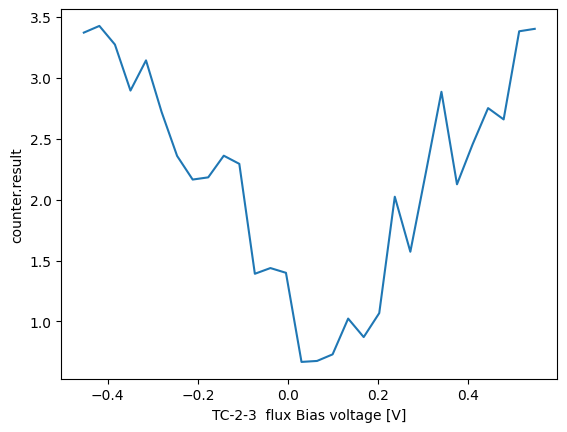
For optimal QPU performance, each physical component should be “parked” to a flux voltage value that minimizes parasitic interactions with the neighbouring components. The parking is part of the standard calibration of an IQM QPU, but we can investigate its effects by running a two-qubit gate on a connected pair while sweeping a neighbouring coupler’s flux voltage. We should see the gate performance getting worse as we get further away from the correct parking voltage.
Create four circuits to prepare the four states |00>, |01> |10> and |11> and then perform a CNOT gate between the two qubits. CNOT should map |10> to |11> and |11> to |10>, while leaving the other two states intact. We can measure the probability of being in the correct state in all of these cases, which gives us a rough estimate of how much the bad parking affected the gate operation (it should be noted that this is not a scientifically sound method of state/process tomography, but just a simple example for educational purposes).
compiler = get_qiskit_compiler(pulla, backend)

# Prepare |00>
qc1 = QuantumCircuit(2, 2)
qc1.cx(0,1)
qc1.measure([0,1], [0,1])

# Prepare |10>
qc2 = QuantumCircuit(2, 2)
qc2.x(0)
qc2.cx(0,1)
qc2.measure([0,1], [0,1])

# Prepare |01>
qc3 = QuantumCircuit(2, 2)
qc3.x(1)
qc3.cx(0,1)
qc3.measure([0,1], [0,1])

# Prepare |11>
qc4 = QuantumCircuit(2, 2)
qc4.x(0)
qc4.x(1)
qc4.cx(0,1)
qc4.measure([0,1], [0,1])

circuits=[qc1, qc2, qc3, qc4]

# First compile without sweeps
settings = compiler.get_settings(circuits=circuits)
job_definition, context = compiler.compile(
    circuits=circuits,
    components=["QB3", "QB5"],  # run on the pair 3-5
    settings=settings
)

# Run the circuits
job = pulla.submit_playlist(job_definition, context=context)
job.wait_for_completion()

# Instead of the default `job.result()` run the post-processing stages in `compiler` to get the return data in an Xarray Dataset
result = job.result(compiler)
result.dataset
[06-08 17:00:40;I] Waiting for job 019ea789-16f8-78d3-acfd-4da3602d4435 to finish...
<xarray.Dataset> Size: 72kB
Dimensions:                                 (circuit_index: 4,
                                             repetitions: 1000, counter_index: 4)
Coordinates:
  * circuit_index                           (circuit_index) int64 32B 0 1 2 3
  * repetitions                             (repetitions) int64 8kB 0 1 ... 999
  * counter_index                           (counter_index) int64 32B 0 1 2 3
Data variables:
    QB3__c_2_0_0_state_single_shot          (circuit_index, repetitions) float64 32kB ...
    QB5__c_2_0_1_state_single_shot          (circuit_index, repetitions) float64 32kB ...
    QB3__c_2_0_0_readout                    (circuit_index) float64 32B 0.052...
    QB5__c_2_0_1_readout                    (circuit_index) float64 32B 0.124...
    QB3__c_2_0_0_excited_state_probability  (circuit_index) float64 32B 0.009...
    QB5__c_2_0_1_excited_state_probability  (circuit_index) float64 32B 0.070...
counter.result (counter_index, circuit_index) float64 128B ...# In the result dataset, find the bit string probabilities from the data variable "counter.result", and pick the result
# corresponding to each of the four created circuits. Compare the obtained result to the expected theoretical result.
result_for_00 = result.dataset["counter.result"].isel({"circuit_index": 0}).data
print(f"|00> should be mapped to [1.0, 0.0, 0.0, 0.0], we got {result_for_00}, the error is {1-result_for_00[0]}")
result_for_10 = result.dataset["counter.result"].isel({"circuit_index": 1}).data
print(f"|10> should be mapped to [0.0, 0.0, 0.0, 1.0], we got {result_for_10}, the error is {1-result_for_10[3]}")
result_for_01 = result.dataset["counter.result"].isel({"circuit_index": 2}).data
print(f"|01> should be mapped to [0.0, 1.0, 0.0, 0.0], we got {result_for_01}, the error is {1-result_for_01[1]}")
result_for_11 = result.dataset["counter.result"].isel({"circuit_index": 3}).data
print(f"|11> should be mapped to [0.0, 0.0, 1.0, 0.0], we got {result_for_11}, the error is {1-result_for_11[2]}")
|00> should be mapped to [1.0, 0.0, 0.0, 0.0], we got [0.859 0.089 0.017 0.035], the error is 0.14100000000000001
|10> should be mapped to [0.0, 0.0, 0.0, 1.0], we got [0.043 0.047 0.08  0.83 ], the error is 0.17000000000000004
|01> should be mapped to [0.0, 1.0, 0.0, 0.0], we got [0.092 0.853 0.038 0.017], the error is 0.14700000000000002
|11> should be mapped to [0.0, 0.0, 1.0, 0.0], we got [0.049 0.041 0.811 0.099], the error is 0.18899999999999995
# Define the sweep over the couper flux voltage (centered at the correct value, span 0.5V, 30 points)
settings = compiler.get_settings(circuits=circuits)
voltage = settings.controllers["TC-2-3"].flux.voltage
voltage_sweep = voltage.sweep(np.linspace(-0.5, 0.5, 30) + voltage.value)

# Compile and execute
job_definition, context = compiler.compile(
    circuits=circuits,
    components=["QB3", "QB5"],  # run on the pair 3-5
    settings=settings,
    sweeps=[voltage_sweep]
)

# Run the circuits
job = pulla.submit_playlist(job_definition, context=context)
job.wait_for_completion()
result = job.result(compiler)
[06-08 17:00:54;I] Waiting for job 019ea789-4cce-7df0-816b-fc8e0aeb76ec to finish...
# Plot the resulting errors as a function of the flux voltage with native Xarray plotting (Matplotlib)
error_for_00 = 1.0 - result.dataset["counter.result"].isel({"circuit_index": 0, "counter_index": 0})
error_for_10 = 1.0 - result.dataset["counter.result"].isel({"circuit_index": 1, "counter_index": 3})
error_for_01 = 1.0 - result.dataset["counter.result"].isel({"circuit_index": 2, "counter_index": 1})
error_for_11 = 1.0 - result.dataset["counter.result"].isel({"circuit_index": 3, "counter_index": 2})
cumulative_error = error_for_00 + error_for_10 + error_for_01 + error_for_11
cumulative_error.plot()
[<matplotlib.lines.Line2D at 0x749583c084d0>]
Example: Parametric circuits and multi-dimensional sweeps#
You might have wondered why compiler.get_settings(circuits) requires the circuits as an argument. The reason is that the circuit can be a function that creates the actual circuits. The arguments of the circuit generation function then become settings and are thus sweepable, like any other settings.
Compilation also works with multiple sweeps and sweep settings in parallel.
def _my_circuit(n_cz: int = 0) -> list[QuantumCircuit]:
    """Perform ``n_cz`` CZ gates on a pair of qubits."""
    qc = QuantumCircuit(2, 2)
    qc.h(0)
    qc.h(1)
    for _ in range(n_cz):
        qc.cz(0, 1)
    qc.measure_all()
    return [qc]

settings = compiler.get_settings(circuits=_my_circuit)

# n_cz is now a setting in circuit
settings.stages.circuit_generation.circuit
(circuit)
circuit: (Name: "circuit", class:SettingNode) 0
| n_cz | 0 | n_cz |
# Sweep over n_cz
n_cz_sweep = settings.stages.circuit_generation.circuit.n_cz.sweep([1,2,3])

# Sweep over the default PRX amplitude in parallel for the two qubits such that in a single sweep we sweep both amplitudes
amp_sweep = tuple(
    settings.get_gate_node_for_locus("prx", q).amplitude_i.sweep([0.1, 0.2]) for q in ["QB3", "QB5"]
)

# Compile with both sweeps. With multiple sweeps like this the "Cartesian product" of the sweep dimensions is executed,
# such that:
# 1st sweep spot: (n_cz=1, amps=0.1)
# 2nd sweep spot: (n_cz=2, amps=0.1)
# ...
# 4th sweep spot: (n_cz=1, amps=0.2)
# ...
# 6th sweep spot: (n_cz=3, amps=0.2)

job_definition, context = compiler.compile(
    circuits=_my_circuit,
    components=["QB3", "QB5"],
    sweeps=[amp_sweep, n_cz_sweep]
)
HTML(inspect_playlist(job_definition.sweep_definition.playlist, list(range(6))))
Example: Advanced pulse-level access with TimeBox inputs#
IQM Pulla enables pulse-level access for circuits written on the gate level (e.g. Qiskit circuits), but there are phenomena that simply cannot be studied with a gate-level circuit. For this reason, Pulla allows compiling circuits written in the native IQM TimeBox intermediate representation.
As an example, compile and run a single-qubit circuit that consists of
measuring a qubit,
performing an X180 gate, and
measuring again,
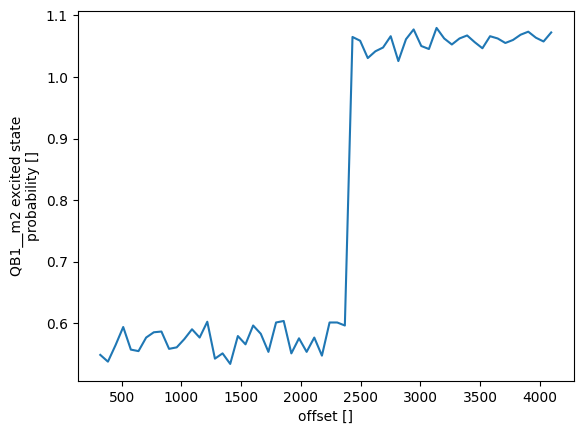
but make the X180 pulse coincide with the first measurement. Then sweep the exact timing of the drive pulse relative to the beginning of the probe instruction. Of course, reading out a qubit while driving an X rotation probably breaks both of the operations and not achieve an X180 rotation. But sweeping the offset from the probe’s start, at some point the actual physical probe pulse has ended and the qubit is projected to the ground state and can perform the X180 rotation. If there is some buffer at the end of the probe instruction (after the physical probe pulse has ended), a more efficient timing is achievable by overlapping the X180 with the probe instruction.
Performing this experiment in the circuit-level is simply impossible. The measurement operation will block its locus (QB1) for its full duration when compiling from the gate-level (as it should for consistent operation), so it cannot overlap with the drive pulse. But working natively in the pulse-level it can!
def _drive_and_probe_overlap_circuit(builder: ScheduleBuilder, offset: int) -> list[TimeBox]:
    """
    Drive and probe pulse overlapping in a circuit.

    Args:
        builder: The ScheduleBuilder (Compiler's default tool for pulse-level compilation).
        offset: When the drive pulse starts relative from the start of the probe pulse. In integer samples (sampling rate 2 GHz).
    """
    m1 = TimeBox.composite(builder.measure(("QB1",))(key="m1"))
    m2 = TimeBox.composite(builder.measure(("QB1",))(key="m2"))
    prx = builder.prx(("QB1",)).rx(np.pi)
    # Put PRX "inside" the probe TimeBox so the instructions overlap
    drive_channel_name = builder.get_drive_channel("QB1")
    prx_instruction = prx.atom[drive_channel_name][0]
    probe_schedule = deepcopy(builder.resolve_timebox(m1, neighborhood=0))  # deepcopy, otherwise the cached result would get altered
    probe_schedule[drive_channel_name] = Segment([Block(offset), prx_instruction])
    probe_and_prx_box = TimeBox.atomic(probe_schedule, locus_components=("QB1",), label="probe and prx for QB1")
    return [probe_and_prx_box + m2]

compiler = pulla.get_standard_compiler()
settings = compiler.get_settings(timeboxes=_drive_and_probe_overlap_circuit)
offset_sweep = settings.stages.circuit_generation.circuit.offset.sweep(320 + 64*np.arange(60))

job_definition, context = compiler.compile(
    timeboxes=_drive_and_probe_overlap_circuit,
    components=["QB1"],
    sweeps=[offset_sweep],
)

# Inspect the playlist and see that the drive pulse overlaps with the probe instruction and moves to the right with the sweep
HTML(inspect_playlist(job_definition.sweep_definition.playlist, list(range(60))))
job = pulla.submit_playlist(job_definition, context=context)
job.wait_for_completion()
result = job.result(compiler)

# Plot the QB1 excited state probability in the second measurement
result.dataset["QB1__m2_excited_state_probability"].plot()
[06-08 17:01:59;I] Waiting for job 019ea78a-4e1e-7593-98c4-2a0f3b8f6e74 to finish...
[<matplotlib.lines.Line2D at 0x749571205e50>]