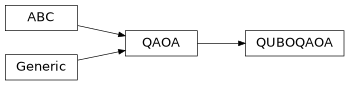
QUBOQAOA#
Module: iqm.qaoa.qubo_qaoa
- class iqm.qaoa.qubo_qaoa.QUBOQAOA(problem, num_layers, *, betas=None, gammas=None, initial_angles=None)[source]#
Bases:
QAOA[QUBOInstance|ConstrainedQuadraticInstance]The class for QAOA with quadratic unconstrained binary (QUBO) cost function.
The class inherits a lot of functionality from its parent
iqm.qaoa.generic_qaoa.QAOA. One new addition is the attributehamiltonian_bqmwhich stores the coefficient of the problem Hamiltonian.- Parameters:
problem (QUBOInstance | ConstrainedQuadraticInstance) – A
QUBOInstanceobject describing the QUBO problem to be solved.num_layers (int) – The number of QAOA layers, commonly referred to as p in the literature.
betas (Sequence[float] | np.ndarray | None) – An optional list of the initial beta angles of QAOA. Has to be provided together with
gammas.gammas (Sequence[float] | np.ndarray | None) – An optional list of the initial gamma angles of QAOA. Has to be provided together with
betas.initial_angles (Sequence[float] | np.ndarray | None) – An optional list of the initial QAOA angles as one variable. Shouldn’t be provided together with either
betasorgammas. The gamma and beta angles are interleaved, so that the first pair of entries corresponds to \(\gamma_1\) and \(\beta_1\) (the angles of the first QAOA layer). The second pair of entries corresponds to \(\gamma_2\) and \(\beta_2\), etc. …
Attributes
The BQM representation of the problem, taken from the input
QUBOInstance.The graph whose edges / nodes have weights
biasequal to the coefficients in the problem Hamiltonian.Returns an upper-triangular matrix of the ZZ interactions between the variables.
Returns a
ndarrayof the local fields of the model (Z coefficients).Methods
- property hamiltonian_bqm: BinaryQuadraticModel#
The BQM representation of the problem, taken from the input
QUBOInstance.
- property hamiltonian_graph: Graph#
The graph whose edges / nodes have weights
biasequal to the coefficients in the problem Hamiltonian.
- property interactions: ndarray#
Returns an upper-triangular matrix of the ZZ interactions between the variables.
If the Hamiltonian representing the problem is
\[H = \sum_{i<j} J_{ij} Z_i Z_j + \sum_i h_i Z_i\]then this method outputs \(J_{ij}\) as upper-triangular square matrix
ndarray. Note that these are different from the off-diagonal elements ofqubo_matrixof the inputproblembecause the QUBO cost function has different coefficients than the Hamiltonian.
- property local_fields: ndarray#
Returns a
ndarrayof the local fields of the model (Z coefficients).If the Hamiltonian representing the problem is
\[H = \sum_{i<j} J_{ij} Z_i Z_j + \sum_i h_i Z_i\]then this method outputs \(h_{i}\) as 1-dimensional
ndarray. Note that these are different from the diagonal elements ofqubo_matrixof the inputproblembecause the QUBO cost function has different coefficients than the Hamiltonian.
Inheritance